Emily Burgis


Leadership Artifact #2: Christo as an Authentic Leader
Course: Foundations of Leadership
Date: Fall 2013 Instructor: Dr. Diana Petrarca
About the artifact:
This artifact is a presentation. Its original form is PowerPoint but it has been converted to a video for better web viewing. It looks at the artist Christo and analyses how he fits into the Authentic Leadership model. The presentation includes information on the artist, information on the Authentic leadership model, example artwork, written analysis and the author's audio analysis. I relied heavily on the work of Bill George’s (2011) Discovering Your Authentic Self for the theoretical framework. The study done by George, which was the basis for the model, was not focused on identifying traits, skills or styles that lead to success (George et. al., 2011). Instead, the interviewers looked at how leadership emerged for each leader. From these 3000 pages of transcripts, they drew up conclusions about how people became authentic leaders.
Reflection:
I chose to include this artifact in my portfolio because I think it represents a synthesis of my learning in many different ways. Additionally, I think it speaks to my diversity. With every project I took on throughout my M.Ed I wanted to try to find a new way to approach the work. I wanted my professors to enjoy reading my assignments because the assignment offered a new perspective and also opened up a new part of who I am. For this task I got to explore one of my favourite artists who is not well known in common culture. I actually hoped Dr Petrarca had not heard of him or his style of work so it would be new and fresh for her. Just like some of my artifacts, it highlights my passions. In this case: art.
As I went through the Foundations of Leadership course I was searching for a leadership style that I identified with. I wanted a model that I could sit comfortably with, especially if it meant leaving room for growth. I really gravitated towards Authentic Leadership. What I think drew me to this model of leadership was that George looked at how leadership emerged for each leader. It was not a recipe, a how-to guide, a user guide. Instead I discovered a model that used a loose framework. Within this framework leadership could take on many different forms and emerge in many ways. After reading so many theories I felt this method was truly all-encompassing in that is allowed for other leadership theories to exist within it. It accounted for situations, behavioural, values, influence, etc.
The artist Christo, I discovered, fit really well into this model. I started by exploring George’s conclusions and organized my presentation by analysing if Christo met each criteria. It was a great exercise for me. Unlike doing a literary analysis, most of my past work on art has been analysis the success of the artwork. While I have thought about the artist in relationship to their work and their community, I had never really thought about analysing the artists themselves. I really enjoyed watching videos of Christo and Jeanne-Claude and it helped me to discover more about these influential artists. This process was different than the literary analysis because it required a lot more inferences. The Authentic Leadership model is not so cut and dry. I had to really look at Christo’s life story and go through hours of video and pages of transcripts to piece together how this impacted him. I had to consider his social and cultural experiences, a key area of my learning from this program. It was a very challenging task. However, I felt rewarded as I began to see that yes, Christo truly is an authentic leader. I feel, strangely, closer to him and his work. I know he, and Jeanne-Claude, have influenced me.
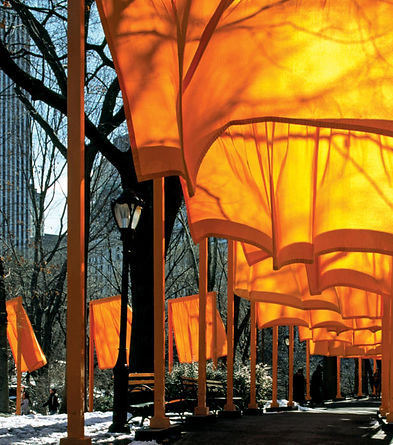
Another area of learning for me was reflective. As I went through this course I kept trying to figure out what kind of leader I was, and what kind of a leader I wanted to be. When I saw Transformational Leadership I wanted that one to be me. But for me, that theory has holes-but I will not delve into that here for it is not relevant for my artifact reflection. Authentic leadership, I came to realize through creating this artifact, was more in line with how I live my life. Authentic leaders, I believe, emerge from people who live authentically. This is something I strive to do. I am constantly reflecting on myself, my choices, my experiences and considering how effectual they were. I ask myself, “Who am I?”. In my meditation practice I also explore this concept of the authentic self. Christo’s project, The Gates, was profoundly influential in my life. But it is also metaphorical. I think it as the gateless gate, “mumonkan”, of meditation. As I discuss in the artifact, when I visited The Gates I was not intending to become an artist or an educator. I think that walking through those gates reminded me of my true self and subtlety shifted my direction. I have struggled with my identity as a leader as I think I was lead to believe it existed in opposition to my introversion. This style of leadership confirms for me that I can be both. That in being who I am, embracing my authentic self, I can also emerge as a leader. Without creating this assignment I do not believe the title “leader” would fit so neatly in my identity backpack.
I also think this artifact fits well with the topic of Social and Cultral Contexts for education. In authentic leadership one of the factors is understanding your own life story. In this artifact I explored how the artist's personal history had a impact on how he created. It also impacted his core values. These values were related to his artwork and his leadership style. In learning about the impact of social and cultural contexts I was better able to understand and, at times infer, how his culture and personal history affected his leadership.
My last reason for showcasing this artifact is because it demonstrates my digital literacies. Like my website, I chose this tool with purpose. I felt that it needed to be more linear in nature. However, I did not want to overload my viewer with information on the artist. I wanted the viewer to have choice. I decided to create the presentation in a multimodal way. As the reader goes through this autonomous presentation, they are given information in many ways. It combines images, text, video, and audio. I included academic writing and personal writing, images from the artist and my own. This aligns well with my learning of digital literacies because of the multimodal expression of ideas.
Christo's project of "The Gates" in Central Park, New York City.

Christo and Jeanne-Claude